Friday, August 17, 2012

Being Retired


I haven't really got used to the whole notion of Being Retired. The old war horse, out to pasture. Nothing to do except nibble the odd blade of grass and assemble IKEA. It suggests a terminal finality - crawling the earth waiting for the inevitable onset of osteoporosis, arteriosclerosis, necrosis or whatever other 'oses' are enthusiastically discussed in places where the elderly gather. Nothing could be further from the truth but I have a vivid imagination. Outsourcing retirement to less expensive locations is, like call centres, a viable possibility - the subject of the vastly entertaining 'The Best Exotic Marigold Hotel (for the elderly and beautiful)'  Filmed in Rajasthan, the film's colourful British cast, who for various reasons all find themselves arriving simultaneously at a hotel which, let's say, doesn't quite match the aspirational rhetoric in the brochure, contrast vividly with the equally colourful, teminally noisy, chaotic location with spectacularly inefficient hotel 'management', with all its Indian-ness and borrowed linguistic finery – a kind of Asian Basil Fawlty.  The location was a perfect emblem of an older feudal system and an agricultural economy colliding inescapably with the modern technological India, the melting pot being a perfect metaphor for the way in which the location influenced the lives of the cast, a rather rag-bag collection of retirees all with different expectations, hopes and dreams played by seven superb veterans whose sheer presence carried the action and manipulated the subplots wonderfully.  Much like some of the characters – not the cast - the beautiful old city is very down on its heels now. Extraordinary architecture suffering terribly from dilapidation but at the same time beauty and light peep through the ageing. The overall theme was a willingness to embrace change and having done so the past can reconfigure a future hitherto unimagined, with some very, very funny lines. "You're not worried about having sex at your age?" "If she dies, she dies..."

It’s good for me to get to laugh with the optimists once in a while. Loved it.

Tuesday, August 07, 2012

Slow Noose


It's quiet here - a place to think.
I had meant to post about holidays - but Facebook is immediate and those interested can look there for whatever details entertain them about my recent travels.
I picked up an old, well-used hunting rifle the other day. It had been abandoned for some time. French-made, the triggers a little worn but the barrelling still smooth and the catches sharp, I realised that I still remembered how to use one. It reached quickly to target, its balance good and quick in my hands. I remembered the requisite care to make sure safety was on and the weapon correctly transported. Curiously, it set in train some thoughts about wars, defensive and aggressive, the Syrian conflict uppermost in my mind. I was reminded of a film – oddly - since its action could not take place further than these hectares of wild land. "The Kingdom"  - made in 2007 - is an strange American take on the impenetrabilities of Middle Eastern life. Very well worth a look, depressing though its outcome was. It is this very depression, a realisation that guns and bullets are not the primary currency of warfare here; instead the imperviousness to Western ideology lying at the heart of the Middle Eastern mindset, which prompted these thoughts. 

The Saudis are in many ways the elder brothers of the Kuwaitis - what happens in Riyadh and Jeddah is frequently mirrored in Kuwait, the long reach of the Wahhabist ideology which spawned Al Qaeda (yes, it did, for those who howl 'foul') crosses the northern border without much dilution. I was there for six years, long enough, one might suppose, to have penetrated the outer echelons of society, politics and finance. Truth was, with hindsight, I hardly scratched the surface, but, sadly, imagined that I had. Kuwaiti friends, almost all Westernised or, at least, Western educated, treated me as their friend and brother - the man in the street however, the stallholder or merchant, the electors of  the strict Islamic majority now presiding in government, superficially treated me with respect as is customary in Islamic cultures, the elaborate protocols of guest and host followed punctiliously,  yet I was no nearer to their souls the day I left than the day I first arrived. Islam in the Peninsula is different than Islam overseas. The Holy Places are revered above all else there and the infidel is to be respected but not trusted. He worships a foreign god - his dissolute, immoral ways anathema to the soul of Islam. He is to be kept apart. The notion of Dhimmitude, originating in the 7th century, still applies today to non-Muslims under Islamic rule—whether Jews, Christians or whatever, whether in Saudi Arabia or elsewhere. It began in 628 CE when Mohammed and his forces conquered the Jewish oasis at Khaybar. They massacred many of the Jews and forced the rest to accept a pact, or dhimma which rendered them inferior to their Muslim conquerors. Over the centuries, the ideology expanded into a formal system of religious apartheid. Although many Islamic countries, including Kuwait, do not practise a full-blown variety, the writing on the wall suggests that some would prefer it to be so. There have been rumblings in the Kuwaiti parliament and church building is disapproved of, pursuant to a deathbed hadith of the Prophet that there be only one religion in the Peninsula, namely Islam.  When free speech and human rights clashes with Islam, human rights take second place and First Amendment expressions of tolerance are disregarded.

In Shari’a law, there are official discriminations against the dhimmi, such as the poll-tax or jizya, not curently practised in Kuwait, but the principle remains.

The infidel has fewer legal rights. Jews may not testify in court against a Muslim and have no legal right to dispute or challenge anything done to them by Muslims. There is no such thing as a Muslim raping a Jewish woman; there is no such thing as a Muslim murdering a Jew (at most, it can be manslaughter). By contrast, a Jew who strikes a Muslim is killed.

Originally, a policy of humiliation and vulnerability was followed. Jews and Christians had to walk around with badges or veils identifying them. The yellow star that Jews wore in Nazi Germany did not originate in Europe. It was borrowed from the Muslim world.

The conditional protection of the Dhimmi is withdrawn if the Dhimmi rebels against Islamic law, gives allegiance to a non-Muslim power (in particular, Israel), refuses to pay the poll-tax, entices a Muslim from his faith, or harms a Muslim or his property. If the protection is lifted, jihad resumes. For example, Islamists in Egypt who pillage and kill the Copts can do so because they no longer pay their poll-tax and therefore are no longer protected. There is clear evidence that Morsi's government are at best turning a blind eye to social and religious injustices and at worst encouraging a more muscular application of the principle - a slow noose. Patrick Sookhdeo - well worth a look at his distinguished bibliography -  published a book in 2002 which examined the condition known in Pakistan as “bonded labour”. [A People Betrayed: The Impact of Islamisation on the Christian Community in Pakistan, Christian Focus Publications; Isaac Publishing, ISBN 1-85792-785-0] It illustrates the subservience maintained by fiscal exploitation and indebtedness which led to expropriation and a system of slavery. Likewise, Sookhdeo demonstrates how the inferior status of the non-Muslim can validate an abuse, in theory forbidden by law, and make it irreversible, as for example the accusation of blasphemy or the abduction of Christian women. This crime, still perpetrated in Egypt today, has been a permanent feature of dhimmitude. As Syria shifts on its axis, it remains to be seen whether the inevitable fall of Assad will create a power vacuum which once again will be filled by the hardliners. If so, the slow noose or stranglehold around Israel will tighten as the new masters in Damascus will take their orders from Iranian ayatollahs for whom the medievalist protocols for dhimmi are enshrined in tradition and shari’a law. I am not, characteristically, optimistic, but by way of a final parry, this came to mind. (thanks to SJ and JR via Facebook)


Thursday, July 19, 2012

Stairway to Heaven

I’m not cross. I’m not really very angry or outraged. Except in the deeper places in my soul where I am allowed to smash things and vent my rage on ideas where it won’t matter very much. What is causing this wanton internal vandalism? I have been reading opinions, persuasive, eloquently phrased, but personal, hence demeaning and unnecessary. A friend posted on a well-known social networking site which of itself was quite inoffensive, but the threads where it led turned out to be bile-filled and in some cases, hateful, vituperative and misleading. The theme was, inevitably, interfaith dialogue. I have no problem with the concept, but its proponents all too frequently seek domination of ideas , a logic unassailable, an argument so slickly presented that the opposition can do nothing but curl up submissively and simply give in to its own intellectual extermination and replacement by something else more culturally and morally attuned to the frequencies of present-day life.
A bus full of Israeli tourists was blown up in Bulgaria. Lives were lost and various organizations blamed. This occurred because rhetoric and persuasion has a habit of snowballing into actions which are ultimately counterproductive, violent and destructive. Were this the only course open to us, would it not just be simpler to abandon all pretence at religious belief altogether, bowing down to the logic of the New Atheists, people like Sam Harris and Richard Dawkins, who aim is to inspire us all with the hope that all religions might soon join the dinosaurs in extinction?  At the other extreme, television preachers still fill our ears with their bombast, certain that the glory of their “true church” will never pass from the earth. I don’t know about that but I’m not convinced.

Most symbols celebrate success, Coca Cola, Nike, Microsoft. The evidence of the success of these enterprises dances in our consciousness; at the sound of their names, type face and colour fly instantly to mind. These symbols proclaim a message we are always hungry for, namely, that more is better. Every symbol that pleases us signifies that this thing has succeeded – has climbed over – superseded something else. More!  Larger, sweeter, higher, quieter, better! We seem, as it were, bound and determined, genetically and socially  programmed to struggle for the utmost – wherever that is. But however high things climb, two more conditions always hold. Firstly, something will always surpass our ‘more’ with its ‘more’ and secondly, eventually, it - or  we - will fall. Every great athlete will hang up his shoes, someone will come along who can run faster or jump higher. Windows will close. Promotions will cease and all these symbols will succumb. Is this awful? No, we just think it is, but it doesn’t follow that fading away is awful. The condition of endless rise and fall is just the way things are. Yet what we really wanted was heaven. Once, what could stop us? Not the skies, it seemed. We were Babel builders, heading higher, higher, running our race with all our strength, all our gift. There’s blessing in it, surely. But we could not have heaven by straining for it. Perfection eluded us, even deluded us. Is it real – heaven?

And yet, I do happen to think that there is one enduring symbol left. The power of the Cross can never be replaced by something else. Why? The symbol of the Cross represents apparent failure and extinction. It carries with it a pathway - a way to go whose path is never barred, whose pitch is not too steep, whose goal is never put behind. It is the path of giving by going lower. On this path, there is no end but God, for no matter how low another creature is or has fallen, you, or even I, by the grace of God, can choose to go down a step lower, to be sent down to serve. It is not that we always must, but that we always can. This is freedom. It is not life as we once knew it, but it is the stairway to heaven. It goes down, in the footsteps of the sent-down man.

How easy it is to say it. How very straightforward a choice. But, going out to find the seat at the low place; following the example that was set; ceasing to gasp and scrape to save our life and let go, is the hardest thing possible even as an infinite horizon for freedom and action opens before us.  Energy, intelligence, imagination and love will never exhaust the possibilities for refreshment if we can only discover a way to kneel for the other in perfecting humility. Down that road, following the sent-down man, is found the only country in which we are no longer bound and determined, the only land of the free. In other words, we cease making more of ourselves. In that act, we begin being made by God; being made human, a being made in the image of God, the sent-down man. Until heaven and earth pass away, the sent-down man and his Cross will never pass away, for the way of the Cross is the only road that has no end but God. This is the only common ground; the bedrock of interfaith dialogue is not found in lofty pinnacles of logic, but in the place of grace and service where our intrinsic humanness finds both a listening ear and a voice.

Tuesday, July 17, 2012

Input/Output

I’m here. Probably for a long time – beyond foreseeable at least. Which means I’m not a visitor, a sojourner, a vagabond, even, throwing his hat on the hat stand near the doorway because all I have to do is pick it up again on my way out. I am therefore by default no longer quite able morally to visit Hillsong Paris with quite the same insouciance and light feet. It’s never a good idea to dissect meetings – usually they turn out to be less than the sum of their parts, but just for a change and to make a point I shall on this occasion. We began the second set – there are now two meetings on Sunday morning - with people drifting in during the first – um – song. Truth be told, they’ve done it better, but the song – loud, anthematic and bouncy failed to raise me from my comfortable theatre seat, meaning that more enthusiastic members blocked my view of the stage. As it turned out, this was merciful of them, since the sight of a number of quite grown-up people gambolling around – I can think of no more apposite word – actually made me feel a little bit like getting up and slipping out the back.
There was a guest speaker whose reputation preceded him. Pat Mesiti is a Pentecostal pastor with a gift for motivational speaking – a member as far as I could see of the ‘name it and claim it’ fraternity. As long as the tithe is paid of course.  It seemed to me that I was hearing about a new spin on Jehovah Jireh - The Vending Machine God: input faith, enthusiasm and unfailing optimism and out comes blessing, often immediate – jobs, money, houses, cars, beautiful spouses, clever kids, good neighbours, big churches, and holidays with poolside bars. On stage he seems almost hypomanic which might account for his 'fall from grace' over a moral issue some years ago. For the prosperity gospellers, we are The Happiness Machines: receive the blessings, rely on the promises, act on the commandments and put on a happy face – a big one. Every day, from the moment you get up to the closing of your hapless, gullible eyes, happiness is the aim of life. In the prosperity gospel, God is there for us; we are here for God to bless as the rightful inheritors of the Abrahamic covenant. You don’t really want to listen to a litany of biblical heroes who might have started to throw things had they been present and you know the stories as well as I do. Abraham had quite a long wait for the son of promise, Joseph was sold into slavery, Jeremiah spent most of his time in tears, and as for Job – let’s not go there.
"God has a wonderful plan for your life..."
Hillsong has had its share of criticism and I'm not joining those who throw their hands heavenward in horror, or, like the prophet Ezra, 'sat down, appalled'. I don’t care if churches get rich. I don’t care if the pastor has a Porsche and lives in a house five times bigger than mine. I do care if he solicits what funds I have in order to support it. They don’t, of course. Money collected goes to the causes and ‘ministries’ the organization supports and the bigger you get the more you need and it's this alone which sometimes just sets some people's teeth on edge. Cynically, such organizations may themselves be sources of additional revenue and are run by family members. Critics have suggested, with some justification, that prosperity theology cultivates authoritarian organizations, often with dominionist overtones, some going as far as to suggest parallels with shamanism and the sale of indulgences. I really can’t comment – nether being an anthropologist or a sociologist. But what is interesting to notice is a quite overmastering sense of belonging – the apparent commonality of purpose which pervades the meetings. I wonder if it is this that people are actually buying into. Not being much of a joiner, I’m not impressed but can see the logic driving those that are.
For a long time, I wondered what was missing. I assumed that people reached by Hillsong’s Sunday presentations – with altar calls - would be introduced at some stage to the rather quaint notion of repentance, since it seemed conspicuously absent. Every time. Will I go back? Probably, Joining? Er, no.

Thursday, July 12, 2012

Woody in Rome


If it's Woody Allen, it's probably worth the price of the ticket. A few random ideas, thrown together in what looks like a haphazard way, produces a worthwhile few minutes of either pastiche or comic genius in "To Rome With Love". An American architect, revisiting his old stamping grounds, mentors a young and rather naïve version of himself – or is it himself - with girl trouble. The young man's live-in girlfriend warns him about the impending arrival of her old chumlet, the overwhelmingly attractive, self-absorbed, absolutely believable (if you're twenty) pseudo-intellectual who is coming to stay and with whom he inevitably and temporarily falls in love. She, on the other hand has a meagre clutch of one-liners from Pound, Kierkegaard and Camus, amongst others, that she drops like landmines on demand.
A pair of  honeymooners meeting the relatives stumble upon alternative partners one of whom – quite accidentally – resembles Gina Lollobrigida and sells her body for a living while his other half gets lost on the way to the hairdresser and finds herself a whisker away from seduction by a prominent, toe-curlingly lecherous actor.  Stuffy provincial relatives not amused.
An opera director, consumed with angst and hypochondria was pastured into retirement for attempting to stage 'Rigoletto' with a cast of white mice, is in Rome with his psychiatrist wife – no prizes for casting here – and discovers in his prospective son-in-law's mortician father a sensational singing voice, which, alas, only works for him when taking a shower. A performance of Rigoletto where the male lead is encapsulated naked in a shower cubicle, soaping himself with a loofah required the ultimate sacrifice in good sportsmanship.
A very ordinary office worker suddenly finds himself a celebrity for no discernible reason whatsoever, much like Paris Hilton who is famous for being famous. Cameras and press follow him everywhere, imploring his views on how he likes his breakfast toast, buttered or unbuttered, amongst other things, all hideous and banal.
Do all the plotlines finally and cleverly converge? Er, no. A cast of caricatures with the chemistry of everyone's eccentricities and beautiful Roman backdrops keep things moving. Worth seeing, of only for the fact that many the characters have a habit of hanging around like friendly ghouls in one's subsequent consciousness. 
So much for my little excursion into Art,  I'm off to decalcify the taps. Attaching vinegar-filled condoms overnight works well, one finds.

Sunday, July 08, 2012

Pillar to Post

During a brief absence visiting the UK, the lilies in the garden have bloomed and are sporting petals the size of hubcaps. Hollyhocks are seven feet high, Spartan warriors presiding over an avalanche of botanical activity. Winged pollination is happening on an industrial scale. And, the grass needs mowing. Again.
Breathless transit from pillar A to post B - stopovers punctuated by hours of rapidly moving landscapes - can be unsettling. Returning to England reminded me of the shortness of breath, the partial vacuum I tended to experience before having left it. I remember various departures with a sense of loss tantamount to disappointment, disillusionment, smoggy morality and lack of belonging. I wasn't looking forward much to returning, but, as it turned out, compensations were rich. Rochester, the old, drunken stamping ground, seemed little changed, its twelfth century castle and even older Cathedral presiding over flurries of small High Street shops all celebrating Dickensian characters, was much as I had left it.
The Byzantine themed fresco in the Cathedral was finished, being the first in an English Cathedral for eight hundred years. Its colours almost smelled of fresh flowers.


The Shard, the tallest building in Western Europe with its curiously unfinished spire, like a cathedral that has run out of money, was due to open the day I found myself, courtesy of our hosts, in the Members' Room in Tate Modern  to see the Damien Hirst and Edvard Munch exhibitions.
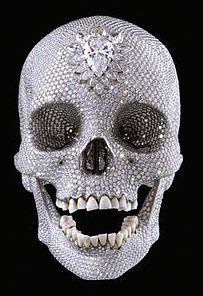
I quite enjoy a brief, exhilarating traverse around an art gallery, but am rather prone to information overload and cannot really manage more than, say, an average seven-year-old when it comes to appreciation. The Hirst exhibition was almost exactly large enough to satisfy my higher Maslow's but I came to the realisation that I was an armadillo when it came to actually capturing the metaphor behind large numbers of painted spots, rooms full of neatly arranged medicine cabinets and surgical instruments, butterflies arranged to look like stained glass windows which reminded me of Sanskrit landscapes, a Black Moon consisting of resin covered dead flies and a neat little excursion through two halves of a cow. Had 'For the Love of God', his platinum cast of an eighteenth century skull covered with diamonds been on show - we missed it by a fortnight - I might have been more impressed. The piece is apparently thus titled because his mother once asked him 'for the love of God, what are you going to do next?' From a distance I think it looks like the Laughing Policeman. On a lighter note, live butterflies in one exhibit seemed inexplicably to be attracted by the colour of Gipsy's trousers. The Munch was little better; both explored themes of death, resurrection and reincarnation which left one uncomfortably aware of one's own mortality. 
The souvenirs were buttock-clenchingly pricey. A roll of DH butterfly wallpaper sold for a modest 250GBP - enough to cover a toilet wall - and limited edition prints with not much on them stamped with various official seals guaranteeing authenticity had a price tag of several thousand. I'd dearly love to understand where art stops and fart begins, but, alas, I cannot.
By way of contrast, it was really quite nice to plan a trip to Oxford. Stripped bare of squadrons of students on bicycles, the town is reclaimed by tourists and locals - the aroma of learning and the stolid bulk of the Randolph was much as I had remembered it, persistent, unrelenting rain notwithstanding. It was good to catch up with an old friend in Oxford. Quintessentially tasteful, unmistakably English, his glass engravings are beautiful, sometimes breathtakingly so. I have owned a few of his pieces over the years and was glad to see him well, happy and a patriarchal grandfather of six. We shared an extended lunch, talked guitars and caught up.

Sunday, July 01, 2012

Town and Country

Clearing spaces - a metaphor for my mental condition
A wise old woman, who will disembowel me should she ever read this, said to me recently "Cerebral transition always runs ahead of emotional change. An open mind helps restless emotions". It turns out she was right. Leaving the security of one culture where one's shirts are ironed and placed in the wardrobe by one's maid in the order in which she has noticed I like to wear them, and a fast 'bey' to the nearest slavey hanging about in the car park gets the car washed has its flipside, temperatures of close to 50 Celsius notwithstanding. Were it just one axial shift, one might be able to keep up. Two, on the other hand, represents a rather more spiky emotional challenge, thus leaving the relative security of Paris within forty-eight hours of arrival for the South was like a slalom run with a few unexpectedly tight turns.
It’s a long drive, even in a new, well-behaved vehicle. People drive differently, undertaking is frowned upon and sudden lane changing unheard of on the autoroute du soleil. Waist-high grasses surround the house and there’s a dead mammal, long desiccated in the Godin, having presumably slipped down the chimney and been unable to escape. The toilet cistern has sprung a leak. There is no ‘bey’ to fix either. Instead a complex sequence of social interactivity is set into motion. A leaking cistern is a job for ‘monsieur le plombier’. In the South, much like in Wales, people are often referred to by their professions. Fortunately, our very own wasta network exists in the form of Gipsy’s brother, who in his time was a world-class speleologist but now spends his time, as we all do, listening to the sounds of the forest surrounding our houses. He knows the original plumber and places a call. Half an hour later-at ten thirty in the evening, the ubiquitous white van arrives. He turns out to have long since retired but such is the esteem held by the family that even a late night call brings him. He has a shock of white hair, a vast expanse of moustache and an accent to stir treacle. No conversation can be begun about the business in hand before an exchange of courtesies – how well the melons are doing, prospects for the vendange and, of course, la chasse. Scratch a French countryman and a hunter is revealed. He makes no apology that his plumber’s van is shared with a large cage for his hunting dogs. Boar hunting is a favourite pastime here and the boar hunting community frequently consists of artisans and craftsmen, thus if their disapproval is incurred, nothing gets done. Conversely, if they have untrammeled access to one’s land – we have a family of boars somewhere about – then they are souls of affability. The cistern is inspected and removed with much eyebrow raising and hand-waggling, where the hand oscillates like a metronome for three or four beats. This is a gesture peculiar to the South and can mean anything from ‘this is going to cost a fortune, chummy’ to ‘no problem at all, old chap-we’ll fix it in a heartbeat’. Turns out that external temperatures of minus fifteen Celsius last winter caused differential contraction of the cistern and its fitments and the porcelain had cracked. Since he himself installed the thing years before, he beamed at me and turned off the water. When we return, he will have fixed it, along with a few other bits and pieces that he noticed on a quick inspection of the bathroom. Bieng. I reach for my wallet, expecting to pay a hefty deposit, but he waved it aside, and with endless beams and waggles, bounced the tiny truck up the road.
Back in Paris, the annual island party is in full swing. All kinds of people turn out, from a toothless lesbian social worker who runs a battered wives clinic, to a visiting archaeologist from the Louvre who is a world authority on a particular kind of Greek vase, to ponytailed superannuated hippies with a, er, passion for horticulture.
I left early and went home to mow the lawn. I really must be getting old.