Tuesday, August 17, 2010

In Rebel Country

The Cévennes are rather like the Appalachians. It might be Scotland, but grander and warmer, with purple heather and pine. Old mountains, worn down into gentle, rolling woodland, the landscape stretching grey and blue to the horizon. Tiny villages with dwellings clustered around either a church or a simple Huguenot Temple. This is the land of the Rebellion where for a hundred years  Protestant Camisard guerillas fought the armies of King Louis for the right to worship freely in much the same way as Wallace harried Longshanks' troops. "Braveheart" could have been filmed here.


During the rebellion, the austere theology of Jean Calvin, Ulrich Zwingli, Martin Luther and Philipp Melanchthon shaped understanding and family Bibles were read illegally while the women watched the windows for approach of the King's troops. Meetings were held out of doors or in specially camouflaged dwellings - a mobile pulpit could in seconds be transformed to look like a small grain silo. This temple was erected after the Revolution when freedom of worship was finally transformed into reality. Many are still in use, while Catholic churches have fallen into disrepair.

This is a disused mill. Brits are buying up these old places, and the old crafts like silk-weaving are dying out. Shame.

Wet String and Hope

Being a long way from a Starbucks, persons hereabouts are infrequently troubled by the Internet, wet string and hope being the connection medium du jour. Blog posts therefore back up, like buses, and three or four arrive at once. So sorry...

Sunday, August 15, 2010

Higher Ground

I miss the mountains. Apart from a brief trip to Lebanon, I haven’t seen them for ten years. Being close enough however to Annecy and the gateway to the Mont Blanc massif was too good to miss. The wild woman herself was more than worth the trip. Standing 4810m, the highest peak in Europe, gave me tantalising glimpses as she shrouded herself in cloud, the summit only partially visible for most of the day. Had I been thinking on my feet, I might have managed a morning’s skiing on La Vallée Blanche but the cable car ride takes an hour and I didn’t have equipment.
 Instead, lunch at a restaurant recommended by a friend at the top of the Col de la Croix-Fry  - no Parisian ‘nouvelle’ here, with chic little diddles of balsamic -  the ham slice on offer would have been sorely missed by its parent animal and sausages the size of cucumbers - then down into Chamonix – inevitably full of grimy unshaven climbers, some of whom, quelle surprise - were English. I spent the afternoon on a glacier, as one does hereabouts. The cable car takes you to its base, and the snowline, blue-black in parts, finishes about 300m higher, torrents of meltwater finding least path distance to the valley below. I must be getting old, the climb – probably no more than half a dozen flights of stairs, at 1450m left me breathless.  Dinner in St Gervais, pleasanter and cheaper than the tourist overkill in Chamonix. Elderly persons go there, you know. For their health.

An Accidental Pilgrim


Heading south from Porte d’ d’Italie. The original intention was to drive to Lyon, where I spent a summer in 1976, the year of what the French still call ‘la grande sècheresse’ when there were no fireworks on July 14 in case of fire. Vagabondage (does this word exist?) has its rewards, however. Three hours down the autoroute  I caught sight of a single sign. “Communauté de Taizé, prochaine sortie”.  I wondered why a tiny hamlet, its significance, perhaps, known only to a relatively small cross-section of population, and miles from anywhere, might warrant its own signage off the highway. On impulse, despite the fact that it was early evening without accommodation booked, I followed a hunch and turned off. It took an hour, getting lost, winding through rolling hills and tiny villages, some with familiar names, like Chardonnay.  As I approached, the number of young pilgrims walking up the hill seemed to increase by the yard. Brother Roger’s original building, acquired seventy years ago, is now dwarfed by a vast, modern structure, slightly reminiscent of the glass-floored church in Capernaum, extended at least twice, flanked by an armada of  large well-organised communal tents and a flotilla of smaller ones. Wooden outbuildings housed barracks, meeting rooms and cookhouses.  I followed the sound of the singing, and overcoming a strong sense of déjà -vu - found myself in a vast covered amphitheatre, dimly lit, listening to the iconic sound of Taizé worship. And this, apparently, was the overflow building. There were at least three onion domes (picture) plus the church itself. Thousands of people sat on the floor, the singing led by a small number of white-robed monks – I had arrived at the beginning of evening prayer. Feeling like a Samaritan at the gate, I stood awkwardly at the door and listened. Services at Taizé are characterised by singing, silence and prayer. During one of the silences, I wandered outside, and found myself outside what appeared to be a crèche – there did seem to be a large number of the congregation inn their 20’s. A calm-looking young woman in a long blue seersucker dress and the obligatory sandals answered my questions, holding the hand of a three year old as she patiently walked him again and again around a tree. “How many people are there here?” I asked. “Oh, this week, about three thousand six hundred”, she replied with a smile. “Is this a special event?” I asked. “Oh, no. Every week the same numbers come”, she said, her German accent making her English sound clipped and rehearsed. “Perhaps six thousand at Easter. If you wish, you can stay.” I didn’t, instead nosed the car down the hill and ate well in Cluny, little changed for five hundred years, beneath the abbey walls. How appropriate.

Tuesday, August 10, 2010

Oafish Chic

The land I know and almost love - the one east of the 30, that is, is a sham. A cardboard cutout, a mirror image, a Romford Rolex or a Chinese Calvin Klein. Here, in the birthplaces of the iconic names in food, wine and fashion, chic has a totally different connotation and is not exportable. Copied, transplanted, yes. The real deal somehow floats effortlessly above all attempts at plagiarism, even with the right labels. Buying Louis Vuitton in an airconditioned bus station somewhere off the Sixth Ring doesn't quite have the same cachet as buying it at the iconic architectural masterpiece at 101, avenue des Champs-Elysées. As a matter of interest, I ran across a 1920’s Louis Vuitton trunk in a B&B in Burgundy the other week, complete with the name of the original owner on the front and its own unique lock with hand-made brass key. At auction, it would have fetched the price of a modest house.
Shopping (window or otherwise) in and around Place Madeleine  - yes, it's the Magdala again; amazing how she seeps in and out of my consciousness - reminds me how lumpen and oafish I really am. Coffee at the original Fauchon. A tea shop containing possibly five hundred different varieties of tea, a crowd gathering outside the discreet caviar store where 1kg of best grey Caspian sells for 3500 euros, to watch the sturgeon swimming in the aquarium window, a fish I have to admit I have never ever seen in the flesh. A shop selling over a hundred different varieties of mustard.
I had to go into the church and restore balance. It’s a beautiful building – I missed the free concert by an hour – a Romanian choir were doing Byrd, Mozart and Fauré. Never mind, Verdi’s Requiem is being sung there later in the month.
Food at one of Paris’ little secrets. At 7:30, I nodded to the maître d' and secured what looked like the last available table. Simple French food, no frills at a price that didn't make the eyes water. When I walked out, a hundred people were waiting in line. I swallowed my pride, pretended to be a tourist and photographed the napkin.

Monday, August 09, 2010

The Myth in the Closet

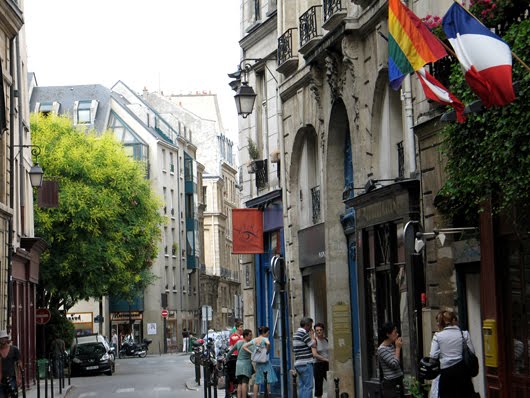
Visiting Le Marais gave me food for thought. Universities offer classes in everything except how to be a ‘mench’ - in Yiddish to be a valuable human being. I share the belief of many that whether they profess faith or they do not, "truth reflects itself in many different ways" and everyone has experienced a sense of mystery in their lives that enhances their quest for divine truth and self-discovery.  This is not bland pantheism, God ‘is that he is’ but the quest for glimpses into who and what the ‘is-ness’ of God is, is hardwired. ( I thought this last quite rabbinical) Man’s individuality is flexible allowing endless strategic possibilities for discovery and expression of what C S Lewis called Grace. Much as light is separated and broken up by dispersion, the determinism of God is metamorphosed  through the prism of humanity. Freedom means that I do what I ought to do, not what I like to do and Man’s individuality is flexible allowing endless possibilities for expression. Light. Is it a particle or is it a wave? It makes no sense to be both, but the instruments don’t lie – the truth is that light is in fact both – teaching the inflexibility of the wavelike nature of light denies its particulate nature.
All this arose because I have been in conversation in recent times with a ‘closet believer’, someone whose pragmatism is occasionally ruffled by glimpses of the river of the water of life. Some months ago, a friend wrote this…Italics mine.
“I've had a thought ...maybe mid-life crises of faith, or even changes in direction actually happen because we are confronted with an ever growing menu of reality entrees and it's just too much.”
Being spoiled for choice does indicate a certain sophistication, perhaps. The trick, I suppose is to actually choose.

Sunday, August 08, 2010

Falafel with Philosophy

A twilight walk around the shared Jewish and gay district is educational with an art-nouveau synagogue and the house of alchemist Nicolas Flamel. Not forgetting the best street falafel north of the Damascus Gate. Hasidic Jews sell tracts cheek by jowl (metaphorically - the men wear ringlets or peyes in Yiddish) with well-toned cruisers oveflowing the bars – educational on a number of levels – I've never seen so many men's underwear shops; the walkabout subsequently decanting me into the Place des Vosges – one of the most beautiful squares in Paris, formerly home to Victor Hugo. Note the philosophy students in conversation.