Tuesday, May 06, 2014

Hammers and Plowshares

Kids in the Park
Sometimes, life just tumbles over on itself, accelerating like a poorly made snowball down a bumpy hill. A few months ago, I was enjoying retirement and trying not to feel guilty for "forgetting" to mow the lawn or wondering when I might find the time to hoover the bottom of the swimming pool. Then, here I came, tossed like a pebble into the clash of cultural Titans which is daily life on this little spit of land jutting precariously into the West Bank like an unwelcome drunk at the wedding. 
Girls on Jaffa Street

Friction wears down the surfaces, however, much as John Kerry must have felt over the months of negotiating between two implacable opponents, one of whom would just prefer to be left alone, and the other wants them dead. Since I last spent an extended period of time here, the wall - the offensive rock to both sides - has been extended so that it becomes more difficult for Palestinian youth, fuelled by Friday rhetoric, to hurl Molotov cocktails over it - and the icon of dissent on which Western liberals so profusely scrawl their ill-conceived messages likening the 'occupation' to Nazism - an irony there - or, worse, apartheid. John Kerry's aside, however much the Administration now back-pedals, gained traction among the twittering classes. The effect has been to isolate. East Jerusalem, mostly grubby and poor, was always foreign and is more so now. The West Bank broods even more darkly, cementing its cultural identities with increasingly grim-faced determination with plasterwork of brittle, mutinous resentment.
Abbas, the survivor (whatever is he still doing in charge?),  has signed agreements with the hounds in Gaza, who, as soon as they gain a toehold, will elect their own in the West Bank, when "currently diluted for political reasons", some of their original Articles of Covenant may well find a ready and willingly gullible audience. 
I am tired. Tired of dissecting out the lies. Tired of defending in the face of the tidal waves of misanthropic fiction in the media. Tired of defending America when she seems less and less competent to conduct a diplomatically civilised game of what is becoming more and more like chance rather than skill. How the Israelis must feel about the behaviour of their long-time ally is beyond understanding. Long ago, they must have realised that bleating to the foreigners won't get the job done.
Yesterday was Yom Hazikaron, or Memorial Day for victims of war and terror. A week ago it was Yom HaShoah, or Holocaust Memorial Day, and today is Independence Day. The juxtaposition of these three events is not without significance. The last commandment of Torah, post 1945, has been, unofficially, "never again" and, perhaps more trenchant, "never stand by". As the tiny, fledgling nation was birthed, architects of its destruction threw themselves at it from all sides, determined that it should never come to maturity. The scale of the invasion in 1948 was astonishing, their response little short of miraculous. They fought with the tenacity of survival, threw their enemies back and had the Jordanians not broken faith, the indigenous Palestinians from over the border would have had their homeland almost seventy years ago. The Israelis have long memories and there was much to celebrate last night, at least on their side of the fence. The Arabs remember this as 'Nakba' or 'catastrophe'.  The question is no longer 'who's to blame?' but 'can Nakba and Independence co-exist in the same space?' They are like conjoined Siamese twins, trumping each other with aces of victimhood.  In the moment, however, the Jaffa Street celebrations overrode any darker considerations.
Google's offering this year - a bit subdued, I think

It was good to mingle as the crowds gathered, for a party that went on all night. Teenagers with shaving foam mercifully restricted their targeting to each other. Gigantic inflatable plastic hammers emblazoned with blue and white were carried by young children who amused themselves by hitting each other with them, the irony of which reminded me of Isaiah 2:4. I flitted like a wraith, unnoticed amidst the optimism and celebration, simultaneously at home and a stranger. 

Saturday, April 19, 2014

Noye's Fludde

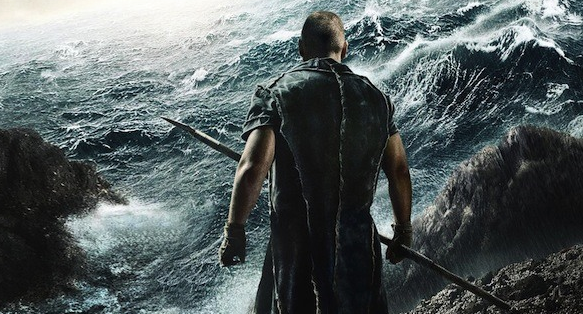
What a lot of twitter, mutter and blog there's been about "Noah". After all, it's a long way from the fifteenth century Chester Mystery Cycle of plays and even further from the Britten opera in which I was once cast, improbably, as the Voice of God. Church leaders have been sounding off about extra-biblical Nephilim, flawed angelology and Big Bang pastiches about Creation. People taking liberties with the historical Tubal-Cain, mangy, lizard-eating stowaway as he is portrayed - Ray Winstone’s South London gangster accent and all - and all kinds of incestuously lascivious unspoken backstories about Noah's sons' wives - or lack of them.

The Ark looks like a gigantic floating wardrobe, as improbably buoyant as this Seine river boat, into which the pachyderms and reptiles lumber, swarm and slither in their multitudes, settling into their prearranged spaces as if by orchestral direction, obediently sleeping, anesthetized with a smoke-wreathed censer, as birds swirl satisfyingly inwards.
Aronofsky's Noah seems to have become disturbed, apparently by the depravity of the rest of his species, so much so that he obsesses on the idea that humanity should not survive. This isn't the first time he's gotten away with stellar portrayals of tortured souls - 'The Wrestler' (2010) almost brought Mickey Rourke back from the dead. In this new incarnation, Noah believes that the Creator must be using his family just to save the animal kingdom and then mankind will simply fade into extinction – a rather second-rate Day Six attempt at the best of the best. If his son's wife has a baby girl, Noah announces that he will take that life to prevent the human race from continuing. Later, with Noah's knife raised over twin daughters, suddenly the myths get busted and there are two of them, Noah and Abraham, conflicted and close to losing reason. No wonder he turned to drink.

It’s fictional. It’s a movie. References to Gnostic thinking, whispers of Kabbala notwithstanding, it’s just Hollywood and it will no more bring people closer to God than the next incarnation of X-men. The Icelandic landscapes are satisfyingly primitive and the special effects remarkable. We briefly wonder where all the wood is going to come from in a barren volcanic wasteland until the miraculous growth of a forest, the “fountains of the great deep” explosively funnel water upwards as the deluge pours down, but the best

characterization is a wily old Anthony Hopkins, suitably wizened by great age, as Noah’s grandfather Methuselah, with magical powers, a fondness for berries and a nice touch in fertility. Six (or maybe even seven) out of ten.

Wednesday, April 16, 2014

Giving Too Much

Illustration from 'The Man Who Gave Too Much'
Even or perhaps especially in churches, there are rituals. They have no material significance, mostly, except for the fact that we all dutifully follow them. One such is the insistence of my local chaplaincy to use the  word "trespasses" instead of "sins" in the Lord's Prayer. 
When I was a child, trespassing meant hopping over the gate on to Farmer So-and-So's land and shooting his birds and was vastly different to sins. You went to hell for those. Or so my imagination told me.
Childhood. What marvellous, fertile ground in which thorns, briars and good seed have an equal chance of successful germination. A friend whom I have never met, but I know, has written a book, one of several as it happens but this one is for children. She is an Oxford English graduate - not one of those whose faces have been screwed and desiccated by criticism of others - instead her use of words is honest, wide-eyed and lyrical, sometimes breathtakingly so. Which is why I say I know her, meaning I respond to her writing with delight as one curious human being to another, almost as a child might.

Which is fortunate, since Anita Mathias' new book "Francesco, Artist of Florence" or 'The Man Who Gave Too Much' is a small, poignant testament to goodness. It is "good seed". It takes good people to create other good people and Francesco the Florentine, always selling his beautifully inlaid work at ridiculously low prices, is a good, good man. He has no head for business, he justifies his knockdown prices by all kinds of emotional acrobatics, and worries that his wife will scold him for not making enough money. This little book is about forgiveness, not least in learning how to forgive ourselves. For this reason, children of a certain age, full of misdemeanor and transgression, unless their fundamental goodness is established early and they learn that "forgiveness of trespasses" carries with it a completeness and totality that extends even to their own follies and mistakes, often fail later to practise the delicate but necessary art of forgiving themselves.

This book is a small, beautifully illustrated tool in the hands of an artful, imaginative parent. It should be read aloud to children, talked about, prayed with.
Anita is a master of awe and wonder. The illustrations perfectly complement a little story with the same captivating prose as "The Little Prince" and will be the kind of book that will remain on a child's shelf, like a favorite stuffed toy, and when they are grown , they will read it again to a new, wide-eyed and curious little person.


Tuesday, March 25, 2014

Diving Bells

CRUISIN'
After a three day diving trip to Eilat, I trudged home from the tram stop feeling a bit, well, elderly, to be honest. My joints hurt and I momentarily cursed Jacques Cousteau for not inventing scuba gear that weighs on land in excess of 65kg, which is a bit like carrying my mother-in-law out of the surf. Fortunately I have no pictures of me - although this might be -  knees momentarily giving way as I hauled my hippopotamine carcass out of the forgiving water on to the beach, gravitationally challenged, and cutting my foot on shard-sharp shingle in the process, being gently helped landward by a muscular Swiss instructor.

Which brought my thoughts to why on earth I didn't start gambolling in the deep when I was a third of the age I am now.
YOU WANT ME TO DO WHAT?

I was brought up in the Fifties and Sixties - if you can remember them you weren't there - as we used to say to the spavined, generationally challenged, creatively enfeebled sons and daughters of the 70's and 80's. I was also reminded of bananas. I eat quite a lot of them these days - a quick-acting carbohydrate fix would have been quite welcome as I staggered drunkenly out of the water the other afternoon - but when I grew up, they were generally unobtainable. As were a few other things. A friend sent this to me the other day and it brought quite the deluge of childhood resonance to the surface. If you're in your sixties, and English-bred, quite a few of these might ring a faint, faint bell, like a suzumushi cricket's.

They didn't have them in the 50's neither....

My thanks to an anonymous and elderly scavenger for the following. I've taken the liberty of making a few changes...

Bananas and oranges only appeared at Christmas time.
All crisps were plain; the only choice we had was whether to put the salt on or not.
A Chinese chippy was a foreign carpenter with funny eyes.
Rice was a milk pudding, and never, ever part of our dinner.
A Big Mac was what we wore when it was raining.
Brown bread was something only poor people ate.
Oil was for lubricating engines, fat was used for cooking.
Tea was made in a teapot using tea leaves and was never green.
Indian restaurants were found in India, it was supposed.
Sugar was regarded as white gold.
Water came out of the tap, if someone had suggested bottling it and
 charging more than petrol for it they would have been laughed off the playground.
Coffee was Camp, and came in a long square bottle with a picture of a chap in shorts on the label.
Cubed sugar was used by snobbish people.
Only Heinz made beans.
Fish didn't have fingers.
Eating raw fish was called poverty, not sushi.
Nobody had ever heard of yoghurt.
Few had heard of and nobody had ever seen a mango and certainly had no idea how to spell its plural.
Healthy food consisted of anything edible.
People who didn't peel potatoes were lazy.
You actually read the fish and chip wrapper after you'd eaten its contents. Especially Page Three.
Cooking outside was called camping, often accompanied by diarrhoea or ingestion of carboniferous carcinogens.
Seaweed was another name for odoriferous bladderwrack and not recognised as food.
"Kebab" was not even a word never mind a food.
Prunes were medicinal.
Surprisingly, muesli was readily available. It was called cattle feed.
Pineapples came in chunks in a tin; we had only ever seen a picture of a real one.

The only thing never allowed on the table was elbows.

Plus ça change....
ONLY POSH SHOPS WRAPPED THEM WITH STICKY TAPE AS WELL

Monday, March 17, 2014

Chasing Feathers

Before this blog was even an impulse in my prefrontal cortex, in the autumn of 2005, having nothing better to do, I agreed, with some small misgiving, to accompany a colleague on a long weekend trip from Istanbul to Van in south-eastern Turkey. For the purpose - wait for it - to 'bird'. Many of the details of that short trip are etched as if with nitric acid on the metallic fabric of my soul, since non-birders, used here as a term of abuse, find the obsessive preoccupation of its adherents about as riveting as gazing at a ceiling.
Called 'twitchers' in the UK, there exists a small but utterly dedicated community of people of both genders whose idea of entertainment is to rise before dawn, dress in appallingly tasteless clothes and trek often through deeply inhospitable places, ignoring sleet, gale and blizzard to record and photographically document small and often really quite unimpressive avians.

Should any of my birder friends read this, sharp intakes of breath will follow. These people are relentless and ferret-fast if new species are spotted. They can assemble tripods, telescopes and lenses faster than a Navy Seal can strip down an M16. Probably best to draw a discreet veil over most of the weekend's events - I can remember white cats whose eyes were differently coloured,  visiting the 'beer shop' - it was during my drinking days - closed off from the world, where infidel guzzlers like myself threw down raki and Coke until horizontal, would you believe, in between peering through lenses to find bustards, shrikes, and flat-footed geese, or whatever they were. My companion's undisguised delight at spotting a small, sparrow-like creature not far from the Iranian border was worth making the trip for. 'There's nowt as queer as fowk', as they say in the North.
I was reminded of this little jaunt, entertaining as it undeniably was, by a movie which I have attempted to see twice. Called "The Big Year" it recounts the adventures of three birders, Owen Wilson, Jack Black and Steve Martin, all making their 'big year' where caution, credit card bills and responsibilities are hurled to the four winds and they spend a year attempting to break the world record for the number of documented species observed. The good, the bad and the ugly motif reimagined, in other words, it's comedic, gentle and entertaining simply because we'd never, ever imagine watching a film about it. Like train spotting but with more varied scenery, the darker subplots revolve around, in order of importance, cheating on the count and spouse abandonment, but I never did get to find out who made the Big Year record, because I nodded off before the end. Twice (TV movies repeat here). I'm sure it finishes delightfully however, and do hope you'll love the ending as much as I know I would have done.

Saturday, March 15, 2014

Young and Old

It's rather fun to change things around. Having had a little play with the look of the blog, and fiddling with templates, fonts and layout,  I wondered what a new small test post would look like. 
I spent last evening at a rather jolly little restaurant at which a frighteningly young colleague's band was performing, I felt a little like the Oldest Member at the golf club, trying hard not to bore the surrounding youth with too many tales of past, long-forgotten gigs and opinions about equipment. They listened kindly, the music was loud but mostly well-crafted  and the food was really quite good, in spite of having to eat it crammed like a lemming in a corner, surrounded by steins of beer.

Watching "Quartet" this afternoon, Dustin Hoffman's directorial debut,  at least had the effect of renewing my youth to some extent, insofar as the stellar British cast were even more superannuated and wrinkly than me. Michael Gambon had, it seemed, stolen his Dumbledore costume from the Harry Potter set. Even a mightily articulate and unashamedly lecherous Billy Connolly had had a haircut and a wide-eyed  Pauline Collins teetered dangerously close to benign, forgetful dementia. Maggie Smith, inevitably, just looked like Miss Jean Brodie, but older. Tom Courtenay stole the show with the best line five minutes from the end.

The film revolves, improbably, around a very comfortable retirement home (read 'Best Marigold' transposed to a well-heeled country house in rural England), inhabited by luminous opera divas and past musical masters all with egos as desiccated as parchment, but still able to turn a bar or two. It's delightful, quirky, quintessentially British and full of people who clearly had huge fun making it.

Monday, March 10, 2014

Clamour and Infamy

There's a conference in town today. Well, not exactly 'in town', more in the suburbs. Bethlehem, to be precise. Beyond the wall where the cabbies can't go. It's going to be quite an event, this third "Christ at the Checkpoint". Several days of conference, keynote speakers to include a prominent Muslim human rights activist, an influential author, several pastors from a variety of denominations, the president of Bethlehem Bible College and many and various luminaries within the Arab Christian community and beyond.

The Ministry of Foreign Affairs has denounced "Christ at the Checkpoint"  in no uncertain terms...

“The attempt to use religious motifs in order to mobilize political propaganda and agitate the feelings of the faithful through the manipulation of religion and politics is an unacceptable and shameful act. Using religion for the purpose of incitement in the service of political interests stains the person who does it with a stain of indelible infamy.”

While it is true that at first glance, the Arab Christian minority has tended to draw the short straw in the political and spiritual street fight that passes for attempts at reconciliation here, the strength of the Establishment response is extraordinary. The subtext, smoothly oiled over with a veneer of spirituality is rather uglier, since it has drawn such pointed criticism from the authorities. There are varieties of opinion, it would appear, and as long as the principal tenets are adhered to, most notably, outspoken support for the concept of  "occupation", participants can attend seminars, visit a checkpoint early in the morning to see for themselves how security is maintained and discuss with like minds. The hated face of Zionism (a minority view amongst many haredi sects) is not condemned outright, merely included in a litany of other unjust and unconstitutional practices. BDS is probably not far below the surface. The words of one of the organisers, Sami Awad, virtuous as they may be, earnest and passionate, carry with them a subtext which many find difficult to digest, namely, the Arab desire to share the rights of homeland in denial of responsibilities to it. He writes "For anything to move forward in the Holy Land, a relationship of trust and respect must be established  between the peoples. Peace is not just negotiated settlements between politicians. Peace is the process of building trust and respect... To be able to see each other with new eyes...understand who the 'other' is...appreciate their culture, heritage, the narrative that they bring to the table...

Superficially, what a worthy objective, but what sacrifice must be made, what concessions made to orthodoxy and truth in order to achieve it? Powerful theological weight is brought to bear to lend support to both hard and soft supersessionism, from hard-line Lutheran dogma that the New Covenant replaces the Old in its entirety, in other words, God had had enough of the Children of Israel in the first century and transferred all Covenant promises to followers of Yeshua Ha-Maschiach to a softer but no less pernicious doctrine that the Church has been unilaterally entrusted with the fulfilment of the promises of which Jewish Israel is the trustee.

This is all very fine, but why are dissenting voices suppressed? I cannot help but feel that this is no genuine fellowship, no Kingdom building, no real rapprochement as the pre-conference literature proclaims; instead a wolf, cunningly disguised as an inoffensive sheep which is cynical at best and propagandist at worst. I'd dearly love to nod vigorously with the peaceniks, but I fear on this occasion, I really can't.